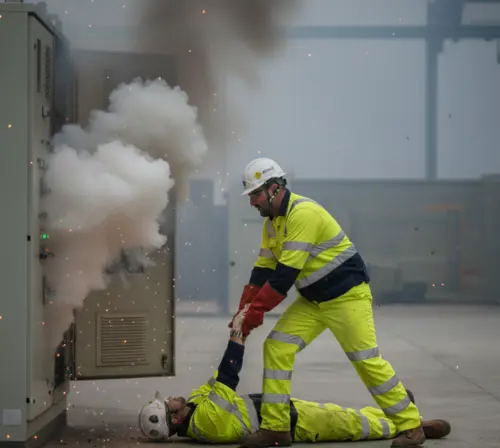
This working around electricity at work safety awareness course provides training and rescue response knowledge for environments where electricity is a consideration, focusing on unique hazards like electrical shock, burns, and falls, working near powerlines or underground services, and providing skills to ensure your safety while managing casualties until professional help arrives.

Key Aspects 

  • High-Risk Setting: Involves powerlines, live electrical apparatus, and related hazards, demanding heightened awareness.
  • Unique Injuries: Focuses on electrical burns, shock, and related trauma from falls or contact with electricity.
  • Rescuer Safety: Emphasizes identifying and minimizing risks to the first aider, a critical component of the training.
  • Specific Procedures: Covers responding to emergencies, basic life support, CPR, and communicating with emergency services in an electrical context.
  • Regulatory Requirements: Mandatory for Australian Electricity Supply Industry workers, with required annual refresher training 

Who Needs It?

  • Workers and managers that require a clear understanding of electrical hazards at work
  • Field technicians and maintenance personnel.
  • Contractors and sub-contractors working around electricity.
  • First Responders / Emergency Services
  • Those responsible for others safety at work

What's Covered?

  • Risk assessment and risk management
  • Preparing first aid and rescue equipment.
  • Assessing and stabilizing casualties.
  • Managing electrical shock, burns, bleeding, and other injuries.
  • Reporting and recording electrical related incidents.
  • Human factors

This awareness course does not replace: 

Any regulated requirements for licencing or Nationally recognised training, these are mandatory for Australian Electricity Supply Industry workers, with required annual refresher training 

Units Delivered

The following units will be included in your certificate:

P00847 - Electricity at work safety awareness

Course Delivery

This course can be delivered/assessed in the workplace or at facility organised by the training provider.

Course Durations

Course durations can vary for multiple reasons, so the durations below are the minimum possible amount.

Face-to-Face Face to Face contact time of at least 3 Hours

Recommended, First aid, industry experience

An individual undertaking this course will need to demonstrate the following to be eligible for entry: 

● Physical capability to be able to meet the demands of the practical demonstration skills  

● Capable of working under supervision in a team while being physically able to complete individual tasks relating to conducting patient movement using drag techniques, stretcher, spine board or litter in a low angle environment 

● English language communication skills in reading, writing and spoken language equivalent to ACSF L1

For more information:  https://www.dewr.gov.au/foundation-skills/australian-core-skills-framework-acsf

 For assistance with Literacy go to The Reading writing Hotline:  https://www.readingwritinghotline.edu.au/ 

Alternatively a translator / interpreter may be engaged, please discuss your companies policy requirement with us.


This certificate has an industry recommended renewal period of 60 months

Practical assessments

Prepare for, and undertake work around electrical hazards, respond to incidents 

Identifies hazards, select and apply controls

Recognises, selects, correctly sets up nominated safety equipment / rescue system

Selects PPE appropriate to tasks

Uses a documented SWMS / SOP / First aid / Rescue plan

 Engages in a team safety meeting to plan work

Nominates local team and site safety personnel / rescue team leaders / external rescue & emergency services

Communicates understanding of signs of operational stress in self and others

Responds to internal & external situational cues 

Contributes as part of a team to respond to workplace incident, electricity related scenario

 Applies basic casualty management & movement including spinal care as part of First responder First Aid / rescue team

Uses spoken & written communication to effectively communicate before, during & after scenario

Uses appropriate manual handling techniques in single drag / team lifts for casualty movement

Participates & contributes to a scenario debrief and complete company report 

Written assessments

Completes incident report

Trainer / assessor records skills performance on an observation checklist

This course does not lead to a nationally recognised certificate