Assessment Activities
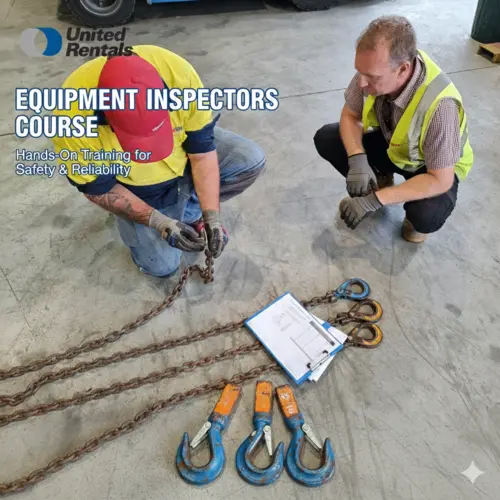
Assessments are conducted during face-to-face training sessions in the workplace and are designed to confirm the participant’s ability to perform inspection tasks in accordance with United Rentals procedures and applicable WHS requirements.
Performance-Based Assessment Tasks
Participants are required to prepare for and undertake lifting and height safety equipment inspections, demonstrating the ability to:
Legislative, Procedural & Risk Knowledge
Locate and recognise relevant legislation, Codes of Practice, and Standards applicable to lifting and height safety equipment
Source and apply company SOPs to inspection activities
Describe human factors that may impact inspectors and the conduct of inspection work
Describe environmental factors that may impact inspection activities
Identify hazards and nominate appropriate risk controls for a range of inspection scenarios
Select and use appropriate personal protective equipment (PPE) for inspection tasks
Equipment Knowledge & Recognition
Participants are required to demonstrate knowledge of basic material properties for alloy metals and synthetic fibres and to recognise the following equipment types:
Height Safety Equipment
Personal fall-arrest systems and components
Full body harnesses and harness attachments
Lanyards (including energy-absorbing lanyards)
Static and dynamic lifelines
Rope grabs and fall arrest devices
Anchorage connectors and anchorage points
Connectors, karabiners, and hooks
Rescue and descent devices
Height safety systems or components as nominated during course delivery
Lifting Gear
Manual and powered lifting equipment
Alloy lifting chains, chain slings, and chain sling components
Synthetic lifting slings (round and flat) and synthetic sling components
Wire rope slings and wire rope sling components
Shackles, eyebolts, lifting lugs, rigging screws, and turnbuckles
Manual chain blocks and lever hoists
Lifting beams, clamps, and lifting devices
Lifting gear systems or components as nominated during course delivery
Technical Information & Compliance
Access and interpret manufacturer technical data sheets and advisory notifications
Locate and interpret equipment markings in accordance with manufacturer guidance
Recognise discard criteria for nominated equipment types as covered during course delivery
Identify commonly encountered failure modes for a range of equipment types
Practical Inspection Skills
Select and correctly set up nominated equipment for inspection
Conduct a methodical inspection using sight, touch, function, and measurement checks
Demonstrate correct use of measuring instruments, including tape measures and vernier callipers
Apply labels and tags correctly, and identify when tagging is not appropriate
Record inspection findings using a register or log
Apply quarantine, fault reporting, and send-for-service/repair procedures
Clean the work area, stow equipment correctly, and report inspection findings on completion
Documentation Requirements
Participants must complete all required documentation to the specified standard, including:
Attendance register and competency outcome record
Lifting equipment inspection record task sheets
Lifting equipment service record task sheets
Theory Assessment
Candidates are required to successfully complete four records of inspection ( two lifting gear & two x height safety equipment) using United Rentals documents.
There is no separate written theory assessment for this course.
Knowledge requirements are assessed through verbal questioning and observation during practical activities.
Other Evidence Collection
The Heightsafe Solutions Trainer/Assessor completes an observation checklist documenting required performance outcomes for each participant.
Photographic and video evidence of task completion may be collected and stored securely with the training records for the session. Participants will be advised in advance. Please notify the trainer prior to commencement if there are security, privacy, or personal concerns regarding the collection of this evidence.