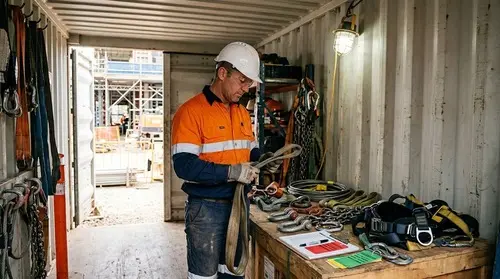
Under the model Work Health and Safety (WHS) Regulations, a competent person is generally someone who has acquired, through training, qualification or experience, the knowledge and skills required to carry out a specific task.

This non-accredited industry training course supports the development of knowledge and skills relevant to inspecting lifting equipment and height safety equipment. Additional practical experience, training or qualifications may be required depending on the equipment, inspection activities and applicable workplace or regulatory requirements. 

Who is this course for

This online course is designed for personnel who are required to inspect lifting equipment and/or height safety equipment, make a serviceability decision, tag or label, report and record the results.

It covers inspection using visual, tactile, and functional checks, in accordance with:

  • Statutory requirements

  • Standards recommendations

  • OEM (Original Equipment Manufacturer) instructions

  • Safety Regulator guidance

The course is also suitable for:

  • Supervisors and managers of inspectors

  • Safety and compliance personnel

  • Anyone seeking a deeper understanding of lifting equipment they may work with or around

What This Course Covers

This course addresses legislative and industry guidance including:

  • WHS Law and Codes of Practice

  • Australian/New Zealand and applicable international Standards

  • OEM / manufacturer technical guidance

  • Standard Operating Procedures (SOPs)

  • Ethics and personal accountability

  • Risk management and human factors

  • PPE requirements

  • Inspection environment ergonomics (lighting, manual handling, inspection aids)

  • Equipment types and terminology

  • Inspection and discard criteria 

  • Service requirements & maintenance requirements 

  • Sending equipment for specialist repair or servicing by authorised agents

  • Tagging, labelling and quarantine procedures
  • Record keeping and inspection reports

  • Inspector duties

Inspectors are trained to understand the application of different lifting gear and/or height safety equipment types, allowing them to focus on known failure points and failure modes.

Training is contextualised to commonly used lifting equipment and/or height safety equipment types across a range of industries and work environments.

Compliance & Duty of Care

This non-accredited industry training course may assist PCBUs and principal contractors in supporting their work health and safety obligations by developing relevant knowledge of equipment inspection requirements and safe work practices that contribute to protecting the health and safety of:

  • Workers

  • Themselves

  • Other persons at the workplace

Skills taught and assessed are applied in accordance with:

  • Commonwealth and State/Territory legislation

  • Australian/New Zealand and relevant international standards

  • Industry codes of practice

Completion of this course alone does not establish that a person is competent or authorised to undertake all equipment inspection activities.

 Important Training & Licensing Notice

This is a non-accredited training course and does not result in a nationally recognised qualification or Statement of Attainment.

This course does not replace statutory licensing requirements for prescribed high-risk work occupations such as:

  • Dogging

  • Rigging

  • Crane operation of some prescribed classes

  • Scaffolding

Additional training, practical experience, assessment or workplace authorisation may be required to perform specific inspection activities.

Check with your relevant WHS regulator and employer for specific competency, licensing or regulatory requirements applicable to your role and the equipment being inspected.

Units Delivered

The following units will be included in your certificate:

P01130 - Online_Lifting Gear & Height Safety Inspector Competent Person

Course Delivery

This course can be delivered/assessed in the workplace or at facility organised by the training provider.

Course Durations

Course durations can vary for multiple reasons, so the durations below are the minimum possible amount.

Face-to-Face face-to-face contact time of at least 1 Hour 30 Mins

Basic computer literacy including emails, with an ability to read, and input information into word and excel documents.

This course involves file sharing from a Google Drive folder, where you can access the documents required for the course.

Have access to a PC, table or mobile phone with internet connection for 60 minutes to complete the online meeting component.

Online meeting and assessment uses Google Meet, we recommend Google Chrome browser for best experience, however Google meet will work on most browser platforms.

Access is required to,

  • Measuring instruments, includes Tape measure and Vernier callipers (digital or analogue)

  • Labels / tags for periodic inspections (including out of service tags) to affix to equipment (we can provide if required)

  • A register or log to record inspection findings information (supplied, completed electronically)

Industry experience is recommended and is an element required to demonstrate your ability to undertake equipment inspection tasks as a "Competent Person"

Under the model Work Health and Safety Regulations, only a “competent person” with relevant training, qualifications or experience can carry out certain notified tasks in the workplace.

This course is authored and delivered in English, please contact us to discuss if this may create a barrier to entry, we are committed to making our training accessible.

This certificate has an industry recommended renewal period of 58 months

Assessment Activities (Online via Google Meet)

Assessment Delivery Format:

All practical performance tasks and knowledge checks are conducted via a live Google Meet session. The entire session is recorded and archived for compliance and moderation purposes. Candidates are required to keep their camera and microphone on throughout the assessment and use screen sharing or external camera feeds (mobile device/webcam) when presenting equipment or documentation.

Knowledge & Documentation Interview (Screen Share & Oral Assessment)

Assessed via live Q&A, oral presentation, and candidate screen sharing of digital or physical documentation.

  • Regulatory & Organizational Compliance:

    • Recognise, and locate relevant Legislation, Codes of Practice, and Australian Standards via screen share.

    • Source, display, and explain the application of company SOPs for lifting equipment inspection.

  • Operational & Risk Factors:

    • Describe human factors impacting equipment inspectors and the conduct of inspection works.

    • Describe environmental factors impacting the conduct of inspection works.

    • Nominate appropriate risk controls for identified hazards across a range of presented inspection scenarios.

    • Identify and explain the selection and use of appropriate PPE for specific inspection tasks.

  • Materials & Technical Knowledge:

    • Describe basic material properties for alloy metals and synthetic fibres.

    • Access, navigate, and interpret manufacturer technical data sheets and advisory notifications online.

    • Describe and apply quarantine, fault reporting, and send-for-service/repair procedures.

This course does not lead to a nationally recognised certificate